Popovers and Hobbyhorses at the Water Gate Inn
One of the most distinctive restaurateurs of 20th century Washington was Marjory Hendricks (1896-1978), owner of the Water Gate Inn, which she operated from 1942 to 1966 on the current site of the John F. Kennedy Center for the Performing Arts. Like all great restaurateurs, Hendricks knew how to keep her guests charmed and entertained, and her Pennsylvania Dutch-inspired eatery was unique in Washington history.
Born in Seattle, Hendricks came to the D.C. area with her family in 1918. After a brief first marriage and early restaurant experience in Reno, Nevada, Hendricks traveled to France in 1929 to study cooking. On her return in 1931, she acquired a failing country club in Rockville, Maryland, which she turned into the Normandy Farm restaurant, a rustic inn of the type that were very popular in the era. The restaurant remains in business today, its name spelled slightly differently.
Eleanor Roosevelt was among the Washingtonians who discovered Normandy Farm, and she is said to have encouraged Hendricks to open a "branch" restaurant in D.C. In 1941 Hendricks bought the former Riverside Riding Academy at 2700 F Street NW as the site for her new in-town eatery. The location was something of a gamble: the Foggy Bottom neighborhood was a semi-industrial backwater at the time. Some even called it a slum. It was far away from most of the city's established nightlife, although across the street stood another former riding facility that had been turned into a supper club, The Stables. Nevertheless, with the tremendous influx of newcomers to the city at the beginning of World War II, existing restaurant facilities—particularly for large groups—were inadequate, and a talented restaurateur like Hendricks was in high demand wherever she might choose to set up shop. Wartime materials shortages kept her from opening the new place until August 1942, after which it soon became a hit with local diners.

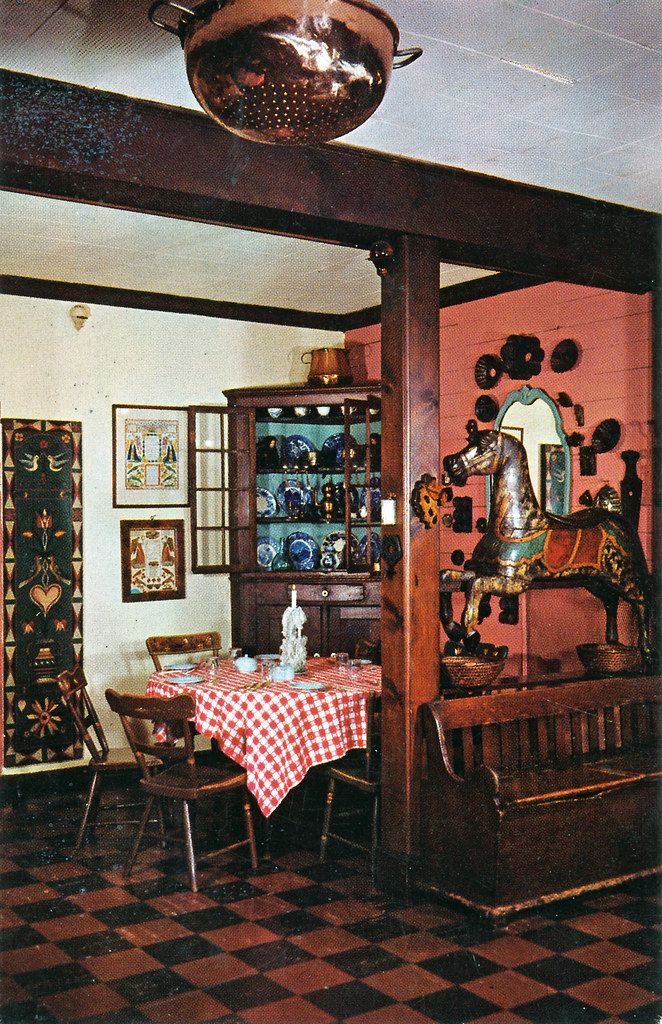
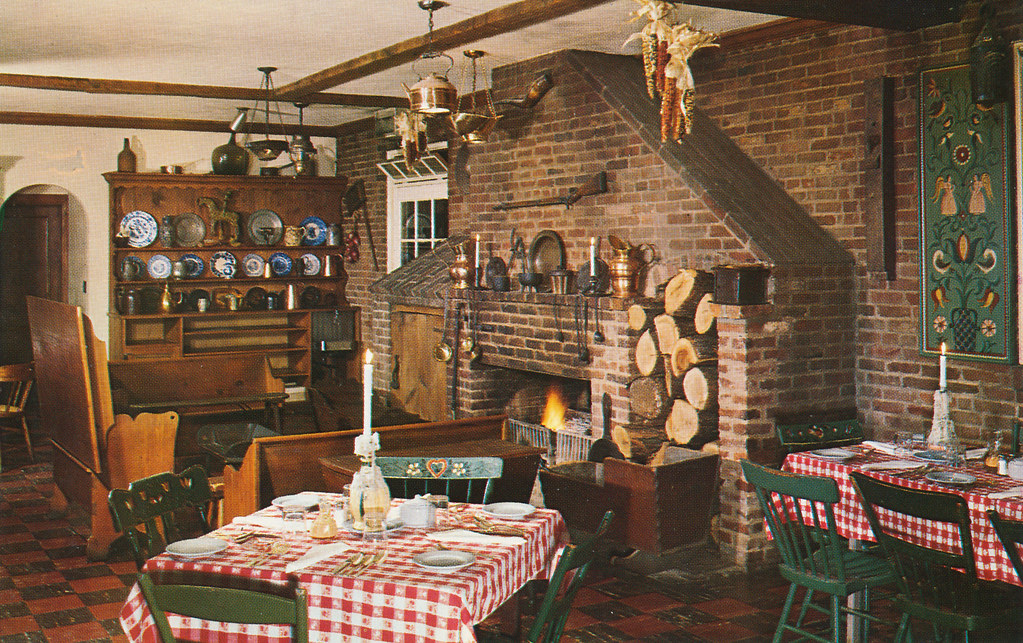
For her new venture, Hendricks decided to adopt a Pennsylvania Dutch motif, reflecting growing interest in the culture and its artifacts. Her sister, Genevieve Hendricks (1893-1976), a well-known interior designer, was in charge of decorating the new space with Pennsylvania antiques, including a number of old hobbyhorses, which became emblematic of the new restaurant. Large windows offered an enchanting view of the Potomac River, and the quaint décor gracing the former stables’ heavy wooden carpentry lent a cozy, rustic atmosphere to the restaurant, which customers found very appealing.

For many of the authentic Pennsylvania Dutch dishes offered at the Water Gate, Hendricks relied on Flora G. Orr (1893-1953), a long-time friend and culinary consultant who developed recipes and trained the kitchen staff. Several Water Gate Inn dishes were consistently singled out by critics and customers alike as especially memorable, including the popovers, which had first been introduced at the Normandy Inn. The inn’s menus would usually list a traditional dish, such as the unpronounceable “Sigh Flaysch Rick Mays El mit Rode Graut” (pork tenderloin cooked with red cabbage) or the popular “Shrimp Wiggle Esche Puddle” (shrimp and peas in cream sauce). Other dishes included traditional pork-and-sauerkraut recipes, layered dishes called Gumbis (shredded cabbage with layers of fruit and/or meat), as well as new recipes inspired by traditional Pennsylvania Dutch techniques. One dish, Chicken Barbara (battered chicken breasts with cream sauce), was so successful that Hendricks trademarked the name. The dish, she claimed, was an impromptu concoction invented for a finicky customer and named after his girlfriend.
In 1960 the restaurant was first threatened by plans for the new National Cultural Center, which would become the Kennedy Center. While the inn was not directly in the footprint of the proposed center, architect Edward Durrell Stone felt that additional green space was needed around the center, which would necessitate removal of the inn. Hendricks fought back, urging her patrons to write their congressmen to protest the plan. "This product of private enterprise, the culmination of the owner’s thirty years in the distinctive restaurant business, and means of livelihood of ninety employees, would be destroyed," she warned.
The restaurant stayed open until 1966, when Hendricks finally reached an agreement with the government on the sale of the property, reportedly for $650,000, significantly less than the $1 million she had hoped for. With bulldozers already rumbling all around it, the inn closed in May. “No more Dutch noodle soup, piping hot popovers with melting butter, rich Mennonite chicken, oven-baked loin of veal with Pennsylvania egg noodles, fresh yellow squash, bread-and-butter pickles and apple-tart pies,” the Evening Star’s John Rosson lamented.
Hendricks at first thought she might open a new restaurant, and she had purchased the old Childs Restaurant at 2 Massachusetts Avenue NW (see our previous post about Childs) in 1961 with that in mind. The new restaurant never materialized, and Hendricks instead ran the Renaissance Gift Shop in the space for several years. By the time the Water Gate Inn closed she went into full retirement. Hendricks died in 1978.
Illustrations are all from postcards in the author's collection. A version of this article will be included in the forthcoming book, Historic Restaurants of Washington, D.C.: Capital Eats, to be published by History Press, Inc., in September 2013.
To receive Streets of Washington by email: click on this link and choose "Get Streets of Washington delivered by email" from the Subscribe Now! box on the upper right hand side of the page.
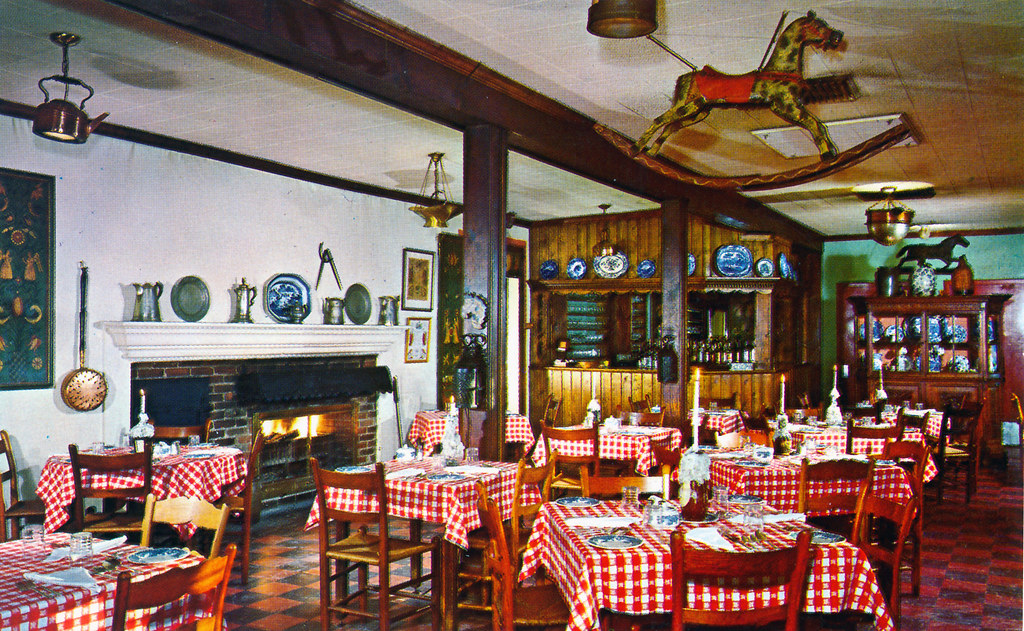 |
| Interior of the Water Gate Inn (author's collection). |
Eleanor Roosevelt was among the Washingtonians who discovered Normandy Farm, and she is said to have encouraged Hendricks to open a "branch" restaurant in D.C. In 1941 Hendricks bought the former Riverside Riding Academy at 2700 F Street NW as the site for her new in-town eatery. The location was something of a gamble: the Foggy Bottom neighborhood was a semi-industrial backwater at the time. Some even called it a slum. It was far away from most of the city's established nightlife, although across the street stood another former riding facility that had been turned into a supper club, The Stables. Nevertheless, with the tremendous influx of newcomers to the city at the beginning of World War II, existing restaurant facilities—particularly for large groups—were inadequate, and a talented restaurateur like Hendricks was in high demand wherever she might choose to set up shop. Wartime materials shortages kept her from opening the new place until August 1942, after which it soon became a hit with local diners.
For her new venture, Hendricks decided to adopt a Pennsylvania Dutch motif, reflecting growing interest in the culture and its artifacts. Her sister, Genevieve Hendricks (1893-1976), a well-known interior designer, was in charge of decorating the new space with Pennsylvania antiques, including a number of old hobbyhorses, which became emblematic of the new restaurant. Large windows offered an enchanting view of the Potomac River, and the quaint décor gracing the former stables’ heavy wooden carpentry lent a cozy, rustic atmosphere to the restaurant, which customers found very appealing.
For many of the authentic Pennsylvania Dutch dishes offered at the Water Gate, Hendricks relied on Flora G. Orr (1893-1953), a long-time friend and culinary consultant who developed recipes and trained the kitchen staff. Several Water Gate Inn dishes were consistently singled out by critics and customers alike as especially memorable, including the popovers, which had first been introduced at the Normandy Inn. The inn’s menus would usually list a traditional dish, such as the unpronounceable “Sigh Flaysch Rick Mays El mit Rode Graut” (pork tenderloin cooked with red cabbage) or the popular “Shrimp Wiggle Esche Puddle” (shrimp and peas in cream sauce). Other dishes included traditional pork-and-sauerkraut recipes, layered dishes called Gumbis (shredded cabbage with layers of fruit and/or meat), as well as new recipes inspired by traditional Pennsylvania Dutch techniques. One dish, Chicken Barbara (battered chicken breasts with cream sauce), was so successful that Hendricks trademarked the name. The dish, she claimed, was an impromptu concoction invented for a finicky customer and named after his girlfriend.
In 1960 the restaurant was first threatened by plans for the new National Cultural Center, which would become the Kennedy Center. While the inn was not directly in the footprint of the proposed center, architect Edward Durrell Stone felt that additional green space was needed around the center, which would necessitate removal of the inn. Hendricks fought back, urging her patrons to write their congressmen to protest the plan. "This product of private enterprise, the culmination of the owner’s thirty years in the distinctive restaurant business, and means of livelihood of ninety employees, would be destroyed," she warned.
The restaurant stayed open until 1966, when Hendricks finally reached an agreement with the government on the sale of the property, reportedly for $650,000, significantly less than the $1 million she had hoped for. With bulldozers already rumbling all around it, the inn closed in May. “No more Dutch noodle soup, piping hot popovers with melting butter, rich Mennonite chicken, oven-baked loin of veal with Pennsylvania egg noodles, fresh yellow squash, bread-and-butter pickles and apple-tart pies,” the Evening Star’s John Rosson lamented.
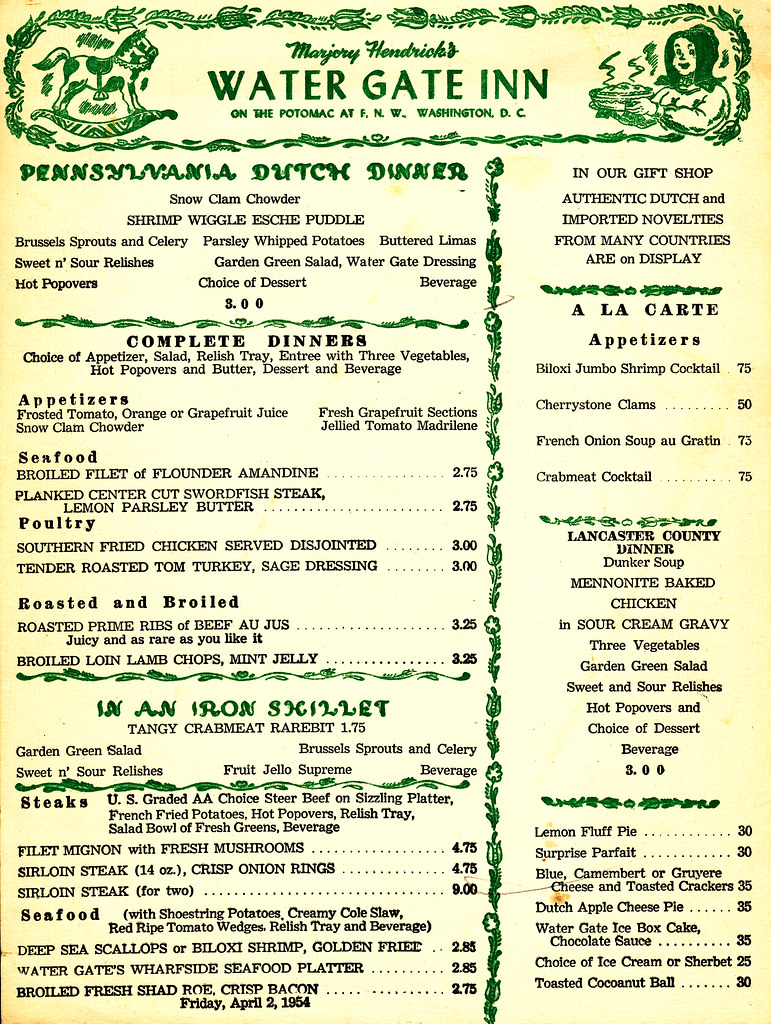 |
| Menu from the Water Gate Inn dated April 2, 1954 (click to enlarge). |
Illustrations are all from postcards in the author's collection. A version of this article will be included in the forthcoming book, Historic Restaurants of Washington, D.C.: Capital Eats, to be published by History Press, Inc., in September 2013.
* * * * *
To receive Streets of Washington by email: click on this link and choose "Get Streets of Washington delivered by email" from the Subscribe Now! box on the upper right hand side of the page.


Is there any connection between the Water Gate Inn name and the residential / office facility that was later built next door and was made infamous by Dick Nixon?
ReplyDeleteOr is this area of the Potomac referred to as the "Water Gate?"
Both the Watergate complex as well as this inn are/were in the vicinity of the spot where Rock Creek empties into the Potomac River. That is the historic water gate that both names reference.
DeleteI have heard that: the original water gate was the first gate entering the C&O Canal from the Potomac (where Rock Creek enters the Potomac next to Thompson Boat House) but Tom Cochran has argued the original "watergate" was the river entrance to the Mall built behind the Lincoln Memorial (but never really used for that purpose). The idea, I guess, being it was the "gateway" to the Mall from the river. See http://greatergreaterwashington.org/post/15508/do-you-know-the-other-watergate/
DeleteThanks Marcus. "Watergate" seems to be a generic term that can refer to any lock on a canal, thus its use in this context as the entrance to the C&O Canal, as you point out. While the location is where Rock Creek meets the Potomac, the watergate is indeed more specifically the first lock on the canal in this case. The steps at the Lincoln Memorial are just another example of a nearby landmark being named after the old watergate, as the inn and the hotel were.
DeleteThanks for posting this. Very interesting! Do you have a source for the fact that the Watergate Steps, the Water Gate Inn, and the Watergate Complex are all named after the canal lock? From Wikipedia: "The name of the complex was derived from the terraced steps west of the Lincoln Memorial that lead down to the Potomac River.[22][28] " Footnote 22 is to a book titled "AIA Guide to the Architecture of Washington, D.C." written by Gerard Moeller & Christopher Weeks. Footnote 28 is to a Washington Post article by the Answer Man. http://en.wikipedia.org/wiki/Watergate_complex...
DeleteSounds like we have a kind of domino effect going on here. The Watergate Complex is officially named after the steps, which were named after the canal lock. I think I was trying to look for the root source of the term, but I need to be careful, because not every landmark was officially named after the original source. Thanks for the message and the correction!
DeleteIt has been a debate among friends and the AIA Guide seems to be the only authoritative source. Everything else references word of mouth or legend. If you have anything that connects all the names or shows that the Watergate Steps were named after the canal lock, it would be greatly appreciated.
DeleteVery interesting! Great post.
ReplyDeleteGreat article! I love reading about old DC restaurants. I look forward to the book. Any chance you discovered any old recipes from this restaurant?
ReplyDeleteYes, I'm planning to include a recipe from the Water Gate Inn in the book.
DeleteWhere was this in relation to Heurich's brewery? I was under the impression that the Heurichs owned that land and gave it to the federal government.
ReplyDeleteHeurich's was just to the south of the Water Gate Inn. The government needed the whole area for the new building and the surrounding landscape.
DeleteOh, this article really brought back memories! My husband was stationed at Aberdeen Proving Grounds, when a friend introduced him to Marjory and her charming restaurant. He took me there several times and there was always a line of hungry folks waiting to get in. She explained to us that her restaurant was being taken through eminent domain. We were astonished that something like that could happen. We wrote our congressmen on her behalf. Unfortunately, she lost her restaurant. I have thought a lot about her this past year, as I had my land taken through eminent domain. When government decides it wants what is yours, it takes it.
ReplyDeleteDuring construction of the Kennedy Center, the restaurant building was used as offices for the General Services Administration which managed the construction for the Kennedy Center Trustees. I was a project manager for Pierce Associates, the mechanical contractor, and spent many hours in construction meetings in the building.
ReplyDeleteMy grandparents ate at the restaurant and purchased me a plastic rocking horse pencil sharpener souvenir. It is still in very good condition and is quite old. Glad I found your pictures of the restaurant it looks like a beautiful place.
ReplyDeleteMy grandparents ate at the restaurant and purchased me a rocking horse pencil sharpener souvenir. It is in great condition and is quite Old. Glad I found your pictures of the restaurant it looks like a beautiful place
ReplyDelete