At 2 Massachusetts Avenue NW, where North Capitol Street intersects close to Union Station, stands a rather striking SunTrust bank building. How did this stately little building with its big windows and rough, pumice-like walls land on this corner, and why is it put to such nondescript use? Well, it's had a number of lives through the years. Designed as a restaurant, cheery and inviting, it ended up, among other things, as the setting for a protest demonstration in the civil rights movement and has had a number of tenants through the years.
. Long before there were McDonald's or Wendy's or Burger King restaurants, there was Childs, a highly successful, early 20th-century chain of lunchrooms that started in New York City and eventually spread nationwide. There were at least three in Washington, including the Massachusetts Avenue restaurant, which was constructed in 1926.
Samuel (1863-1925) and William (1866-1938) Childs, two brothers from New Jersey, had opened their first restaurant in New York City in 1889, at a time when casual consumption of food at lunch counters was just beginning to become popular. As described by Virginia Kurshan in a 2003 landmark application for a New York building, the Childs brothers capitalized on a few simple ideas. They conveyed a sense of cleanliness by using white-tiled walls and floors, white marble table-tops, and waitresses dressed in starched white uniforms. Their restaurants were designed in an "austerely elegant" style, with bentwood furniture, mirrors, and exposed ceiling fans "to complement and also to represent the simplicity and purity of the food," according to Kurshan. Childs' emphasized fast service and made money by turning over tables quickly, in part because the hard surfaces discouraged people from lingering. Another signature feature of early Childs restaurants was a chef in the front window preparing flapjacks to catch the attention of passersby.
commentator H.I. Phillips summed up the style of these restaurants with characteristic wit in 1929:
Speed was the keynote. Buttered toast set new heights in rapid transit, and all previous records held by eggs in flight between kettle and customer were broken....
The first Washington Childs was at 1423 Pennsylvania Avenue NW, just west of the Willard Hotel and close to the Treasury building. It was designed by company architect John Corley Westervelt in 1913 and built for $75,000. Seating 200, it conformed to all the classic Childs parameters, including the white-tiled interior and the flapjack flippers in the front window.
Like any good restaurant, it rarely made news. In October 1918, a minor tiff developed between Childs and the DC food commissioner when Childs raised its prices, contrary to the food commission's guidance. Childs eventually agreed to follow the DC wartime guidelines, which specified precise menu options at fixed prices, according to the
Washington Times. For breakfast, among other options, one could order prunes, cereal, toast, and coffee for 30 cents. Lunch was cheaper, a sandwich—ham, tongue, cheese, salmon, or egg—ran just 10 cents.
One fine day in 1925 a couple of young Texans were checking out automobiles along the stretch of Pennsylvania Avenue near Childs, and they caught the eye of D.C. police detective Frank Alligood, who sensed that all was not good with the two out-of-towners. As they got to the front of Childs, Frank Tunnell, 21, left his buddy, Robert Resson Parker, also 21, out front as he stepped inside the restaurant. He approached the cashier, Freda Schwartz, 22, and asked to see the manager about getting a job as a waiter. It just so happened that Miss Schwartz was counting the weekly payroll at the time. As he waited for the manager, young Tunnell reportedly felt an "irresistible impulse" to grab a stack of bills from the cashier's cage and run out the door. Miss Schwartz, being the fine young lady that she was, "reached for the bills, yelled 'Get him!' and fainted," according to the
Post. Fortunately, eagle-eyed Detective Alligood had been waiting outside, and he gave chase to Tunnell, capturing him in the men's room of the Willard Hotel. Order having been restored, the young man argued from his jail cell that the influence of narcotics was responsible for the irresistible impulse he had felt. It's unclear whether this argument helped his case.
Meanwhile, planning for the second restaurant on Massachusetts Avenue was underway, and it would be completed in 1926. By then, competition was forcing the Childs chain to evolve. The company had always made sure it constructed distinctive, quality buildings for its restaurants, places that would seem special to the common folk who were expected to dine there. But the white-tiled look was getting to be old-fashioned; it looked too much like what it was, a lunchroom. The
New York Times reports that when William Childs was planning a new restaurant on elegant Fifth Avenue, he faced opposition from property owners who didn't want such a lowly enterprise in their neighborhood. Determined to build a distinctive new structure, Childs hired the brilliant modernist architect William Van Alen (1882-1954), who created a tasteful but restrained five-story limestone building with bronze trim inside and no white tiles. It was an immediate hit. Bolstered by this success, Van Alen would go on several years later, in 1929, to design New York City's Chrysler Building, perhaps the ultimate art deco celebration of modernism in American architecture.
But before he worked on the Chrysler Building, Van Alen designed the Massachusetts Avenue Childs restaurant—one of his few works, or maybe his only work, in Washington. It too was clearly meant to be distinctive, and Van Alen knew this is what his clients wanted. Barely legible, Van Alen's name is proudly inscribed in the granite base at the southeast corner of the building. A
Post article that appeared at the time of its opening raved that there was "a lofty dignity and an architectural beauty about it seldom seen in restaurants. It is the type of building Washington needs to make it the city of beauty." A much later article stated that the Childs company "leased property as near as possible to Union Station so 'travelers coming to Washington will see the name Childs in lights as soon as they step off the train.'" While that goal may have been overly ambitious, the restaurant surely must have beckoned travelers as they came out on to Massachusetts Avenue, its huge, brightly lit windows sending a message of warmth on cold winter evenings.
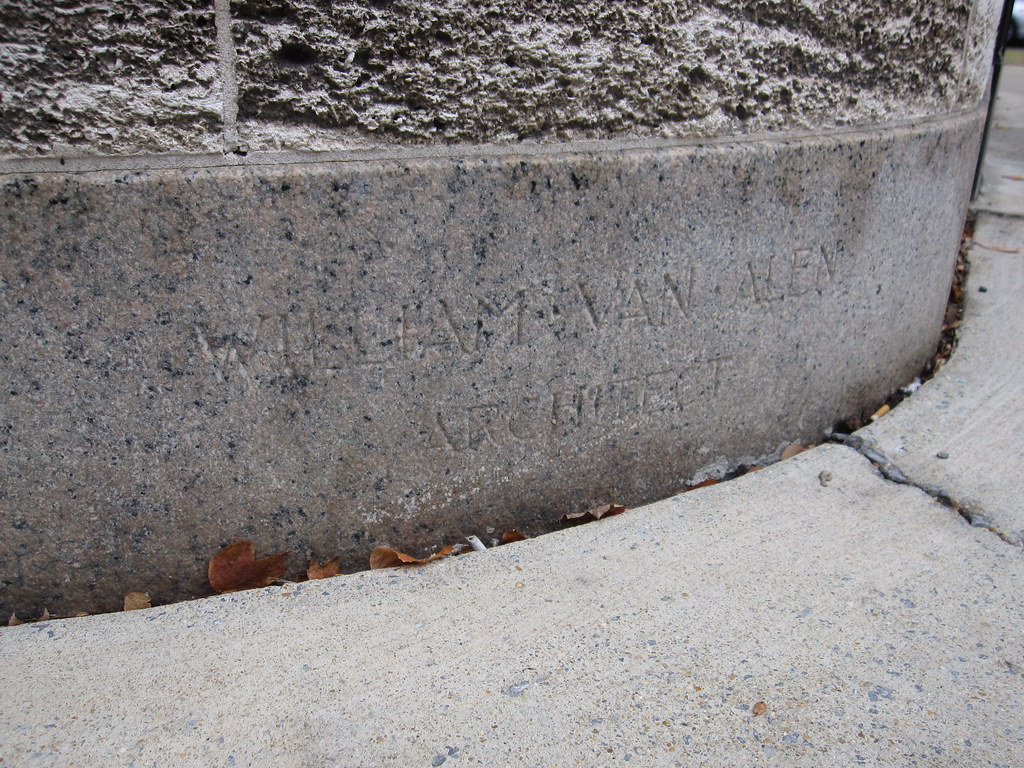 |
| "William Van Alen Architect" inscription. |
The building's exterior is finished in an exotic, rarely-seen stone. According to the
Post article, it was one of only two buildings in the United States made of "Italian Doria limestone, a lava rock from Italy." Christopher Barr has studied this stone in detail and discusses it on his excellent website,
Fossils in the Architecture of Washington, D.C. Barr questions what type of stone it is. It is very soft and now highly eroded, with ancient marine fossils very clearly embedded in it, negating the possibility that it is volcanic. Round decorative medallions, now largely worn away, are carved on the upper part of the walls between the great bronze-framed windows, which were made in Rhode Island.
Inside, the walls are clad in expensive Italian travertine. The color scheme, as the
Post pointed out, was a radical departure from Childs' white-tiled past. The ceiling was painted a robin's egg blue, contrasting pleasantly with the buff color of the limestone walls. Indirect lighting was provided by fixtures concealed around the edges of the ceiling. Travertine columns along the walls were topped with hand-carved scrolls, while wainscoting was of Hauteville marble. The floor was inlaid with Sienna, Cardiff green, Vermont white, and black Belge marbles. The entire one-story structure served as the dining room, so that one was left wondering where the food was cooked. In fact, a large basement was built underneath, extending out much farther than the walls of the ground floor. In addition to the kitchen, storage rooms, washrooms, employee lockers, etc., there was also room for a cafeteria, although it may never have been used as such. All that imported marble and bronze fittings made the restaurant expensive to build, at $175,000, but it demonstrated the company's determination to create a monumental eatery.
The late 1920s and early 1930s brought more change to the Childs chain. William Childs, who took over after his brother Samuel died in 1925, was an avowed vegetarian and decided to adopt a purely vegetarian menu for the chain, to the dismay of customers and stockholders alike. He also instituted a policy of charging for glasses of water, an equally unpopular move. William was finally forced out in 1929, and the company soon brought back meat and free water.
In June 1932, wealthy heiress Evalyn Walsh McLean (1886-1947), owner of the Hope Diamond, was on Pennsylvania Avenue observing the Bonus Army, a ragtag group of World War I veterans who had descended on Washington seeking promised service bonuses that had never been dispensed. McLean wrote in her autobiography that she took pity on the marchers and decided to drop in to the Pennsylvania Avenue Childs to help them out. She ordered 1,000 sandwiches, to be served as quickly as possible. And 1,000 packs of cigarettes. As usual for her, she got her way. (The anecdote is retold in Douglas Evelyn and Paul Dickson,
On This Spot: Pinpointing the Past in Washington, D.C.)
The mid 1930s saw more makeovers to keep the Childs restaurants fresh and interesting. The
Post reported in January 1935 that the chain was redecorating its restaurants according to a variety of different themes. The Pennsylvania Avenue eatery went "Mexican, with adobe, irregular walls, iron railings, scenic paintings, Mexican posters and a hostess resplendent in ruffles and roses behind her ear." Also mentioned was the branch located at 1340 New York Avenue, NW, which was taking on a neo-colonial look, "with paneled walls, wide boards in the floors, antique lighting fixtures and a hostess in hoop skirt." The Massachusetts Avenue location is not mentioned and was presumably already classy enough to keep up a strong clientele. A later
Post article says it was at one time a fashionable eating place for late theater and movie goers.
 |
| A Childs brochure includes photographs of the interiors of the chain's three Washington locations. (Author's collection.) |
In February 1949, a Legislative Assembly and Rally to End Segregation and Discrimination was held in Washington, attracting civil rights leaders from around the country, including
W.E.B. DuBois and former vice president
Henry A. Wallace. On the afternoon of February 13, a group of about 80 attendees at the rally, "members of New York and other out-of-town delegations," according to the
Post, descended on the Massachusetts Avenue Childs and sat at most of its tables, demanding to be served.
This was apparently a very peaceful protest. The participants were not served, and they left after about three hours. But their demonstration was not in vain. Equal access to restaurant facilities became an important demand of the civil rights movement. The following year, Washington activist
Mary Church Terrell, along with three other African-American leaders, walked into a Thompson's restaurant, put soup on their trays, and sat down to eat. They were asked to leave. A lawsuit was promptly filed on their behalf, and it finally led to a court ruling in 1953 that segregated eating places in Washington, D.C., were unconstitutional. Thompson's was a Chicago-based chain and the main rival of Childs; its downtown D.C. cafeteria, now long gone, was located on the southeast corner of 14th Street and New York Avenue, NW, only a few doors down from the New York Avenue Childs.
 |
| The former location of the Pennsylvania Avenue Childs as it appears today. Photo by the author. |
By the mid 1950s, the Childs chain was beginning to run out of steam. Its owners were occupied with developing and operating hotels and allowed the chain to languish. The Pennsylvania Avenue branch shut down in 1951 and was demolished to make way for a parking lot.
 |
| Matchbook photo of the building when it housed the R.A. Humphries company. |
The New York Avenue Childs closed in 1945; its space was taken over by another restaurant. Finally, Childs backed out of its lease on its last D.C. location, the Massachusetts Avenue site, in 1955, closing that restaurant after almost 30 years. The building was bought by the R.A. Humphries and Sons real estate firm for $100,000, only a little more than half what it had cost to build in 1926. Humphries was there until 1967, when the building was sold to the Catholic War Veterans of the United States, which found it quite suitable as a war memorial, adorning the stately travertine walls with long lists of veterans' names. By 1987, they too were gone, to be replaced by a Popeye's restaurant. SunTrust Bank is the latest tenant.
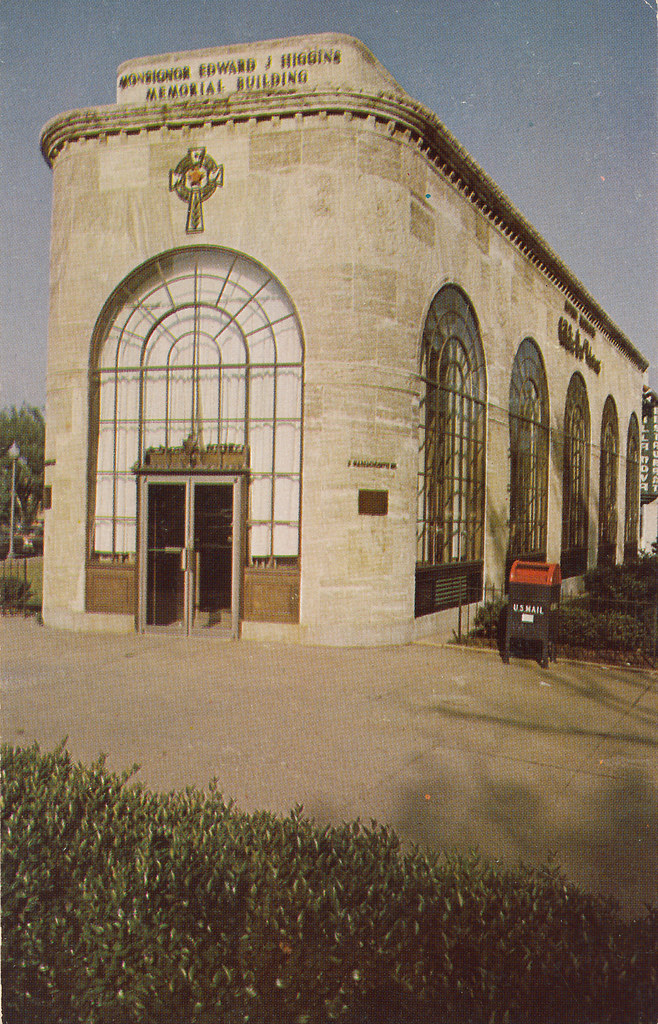 |
| The Childs building was dedicated as the Monsignor Edward J. Higgins Memorial Building in August 1967 (Author's collection). |
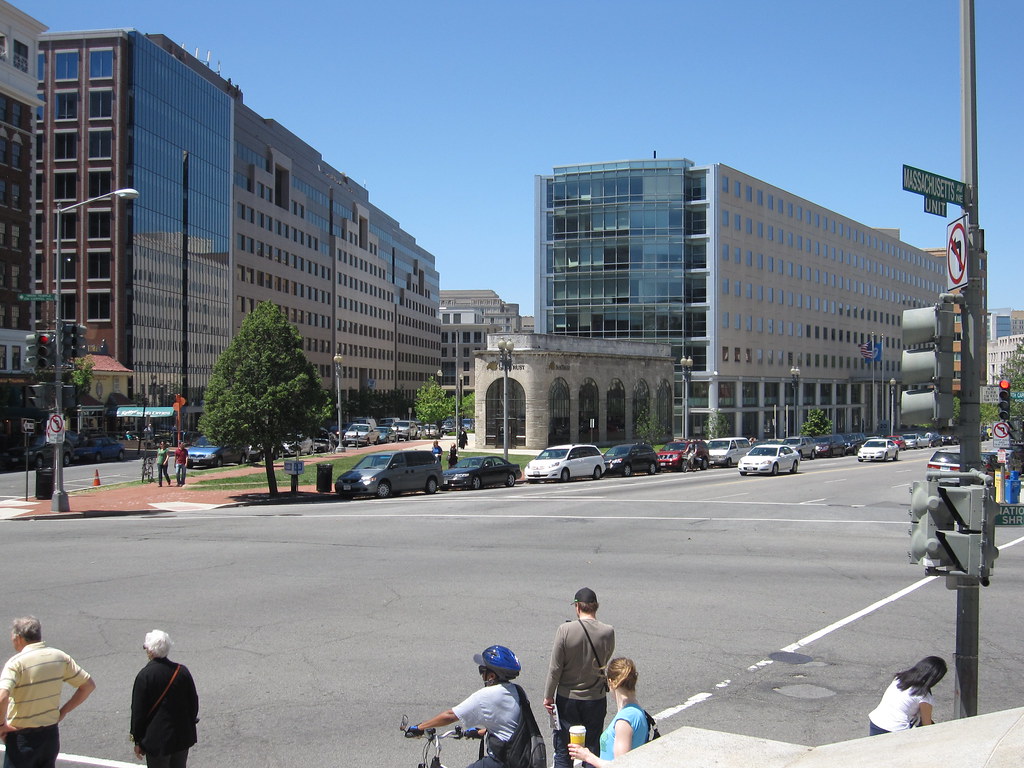 |
| The former Childs restaurant amid modern office buildings. Photo by the author. |
The structure remains a unique architectural memento from the past. While not a major historical landmark, it was designed by a talented architect to stand out from the crowd, and it still does. If it played no pivotal role in the course of history, it certainly witnessed first-hand the seeds of social change. Its primary enemy at this point is probably the weather, which slowly but inexorably is eating away at its exotic stone facade.
Susan Decker contributed to this article.




The 1938 Washington Telephone Directory lists the New York Avenue branch at 1340 NY Ave NW. Thanks for these excellent posts!
ReplyDeleteA fascinating post. Thank you!
ReplyDeleteKeep up the great work Streets of Washington! I'm a big fan of your blog.
ReplyDeleteThanks for identifying the New York Avenue address. I've confirmed it from a 1942 ad for Childs that lists all three DC locations. I've also tweaked the article to include the new information.
ReplyDeleteI've often wondered about this handsome little building at Massachusetts and North Capitol. Thanks for revealing its history. Designed by the architect of the Chrysler Building--who knew!
ReplyDeleteWilliam Childs obviously was ahead of his time -- paying for water and all vegetarian fare? He could have renamed the place Nora's and charged a mint!
ReplyDeleteWhat fascinating revelations; these tasty nuggets of history make my 4th-generation native Washingtonian's inwards even warmer with pride - while aggravating my anger at her mistreatment by self-centered political and capitalist nothings. I had long wondered what that strange but cute little stone shack had originally been, nothing on its outside or its years-long empty interior indicating its origins. To know now that himself who's responsible for one of the [very] few skyscrapers I like had first planted this odd little jewel on the Washington landscape, plus its later rich historical associations, is absolutely wonderful. And while I'm happy it remains, I lament that currently it has been turned into a Necessary Evil - nothing but a dreary bank. Perhaps one day its fortunes may improve - that ripoff outfit with the name only slightly less idiotic than that of the phone company might have cause to unload Old Number 2, and an enterprising restaurateur [but likely of the "High End" variety!] may return the squat little thingy to its intended purpose, and from those fabulous windows again may shine out the vibrancy of a real people place instead of just another dull moneycounters' hideaway.
ReplyDeletei remember when that was Popeye's and I always thought that this grand ole building deserved SOOO much better.
ReplyDeleteMy grand parents and father often enjoyed a meal at the Massachusetts Ave.Child's restaurant.Also there was once a Child's restauant on the boardwalk in Atlantic City, New Jersey during the pregambling days. I once ate their and still remember the huge roast beef sizzling in the restaurant's front window
ReplyDeleteMy parents owned a restaurant at 22, then 24 F, across F st from this building. While we lived out of the city, they kept an apartment on E St., a short walk through the alley (you could walk safely through the alley then). I spent my summers all around this area. My earliest memory is from right down the street, riding on a street car on NJ Ave. since DC Transit pulled the last of the street cars in '62 I couldn't have bee more than 4 at the time.
ReplyDeleteI really enjoyed reading this. So much interesting history! I had always wondered about this building, and now I feel that I know it's background.
ReplyDeleteExtremely cool. I remember it. Used to hang out at Kelly's Irish Times across the street right after college in the early 90s.
ReplyDelete